
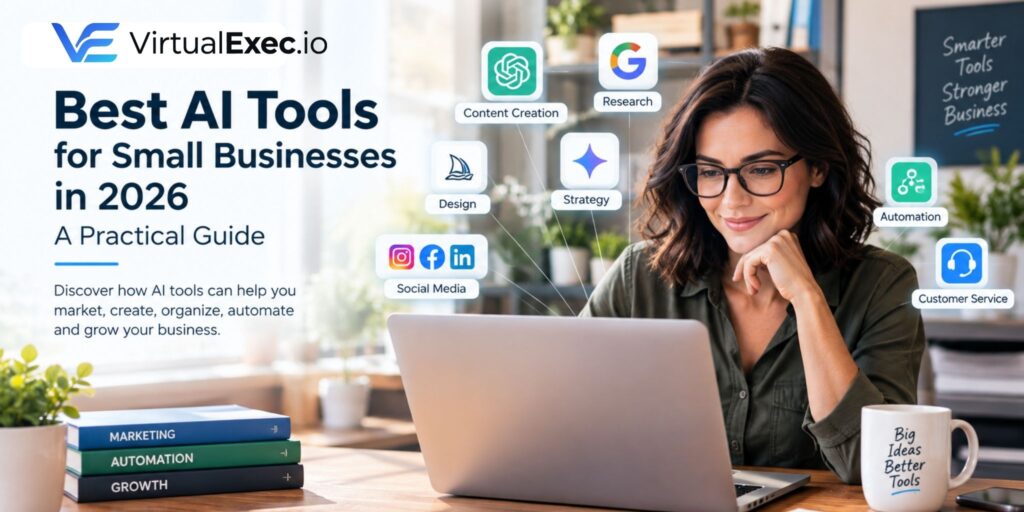
Artificial intelligence is no longer something reserved for large corporations with massive technology budgets. Today, small businesses can use AI to write content, create marketing campaigns, manage customer communication, analyze data, design graphics, automate repetitive tasks, and much more.
The challenge is no longer finding AI tools.
The challenge is figuring out which ones are actually useful.
With hundreds of AI platforms available, business owners can easily become overwhelmed by subscriptions, features, and promises. This guide breaks down some of the most useful categories of AI tools for small businesses and explains how they can fit into everyday operations.
Why Small Businesses Are Turning to AI
Small business owners often wear multiple hats.
You might be responsible for marketing, customer service, operations, content creation, sales, bookkeeping, and strategic planning—all while trying to actually run your business.
AI can help reduce that workload.
Instead of replacing people, the most practical use of AI is helping businesses complete tasks faster and work more efficiently.
AI can assist with:
- Writing marketing content
- Creating social media posts
- Researching competitors
- Developing business plans
- Responding to customers
- Creating graphics and images
- Analyzing business information
- Brainstorming ideas
- Automating repetitive workflows
- Organizing projects and documents
The key is choosing the right tools for your specific business needs.
1. AI Assistants for Business Tasks
AI assistants are among the most versatile tools available to businesses.
Platforms like ChatGPT, Claude, and Gemini can help with a wide range of everyday tasks.
For example, a business owner might use an AI assistant to:
- Draft emails
- Create marketing strategies
- Write website content
- Develop business plans
- Brainstorm product ideas
- Summarize research
- Create customer communication templates
- Analyze information
- Generate reports
The biggest advantage is flexibility.
Instead of needing separate software for every task, an AI assistant can support multiple areas of the business.
Best For:
Businesses looking for a general-purpose AI tool that can help across marketing, planning, operations, and communication.
2. AI Writing Tools
Content creation can consume a significant amount of time.
Businesses need website content, blog posts, emails, social media captions, advertising copy, product descriptions, and more.
AI writing tools can help create first drafts and organize ideas quickly.
However, AI-generated content should not always be published without review.
The best approach is to use AI as a starting point.
A business owner or marketing professional should still review the content to ensure it reflects the company’s brand, voice, and goals.
AI Writing Can Help With:
- Blog articles
- Website pages
- Email campaigns
- Product descriptions
- Social media content
- Advertising copy
- Video scripts
- Press releases
Best For:
Businesses that regularly create marketing or website content.
3. AI Tools for Social Media
Maintaining an active social media presence is difficult for many small businesses.
Creating content consistently requires ideas, writing, graphics, scheduling, and engagement.
AI can help simplify the process.
AI-powered tools can assist businesses with:
- Content ideas
- Caption writing
- Hashtag suggestions
- Content calendars
- Graphic creation
- Video concepts
- Audience analysis
- Campaign planning
Instead of staring at a blank screen wondering what to post, businesses can use AI to generate ideas based on their industry, audience, and goals.
The most effective strategy is to combine AI-generated ideas with real experiences and personality from the business.
Authenticity still matters.
4. AI Design and Image Generation Tools
Professional visuals are important for marketing, websites, and social media.
AI image generation tools now allow businesses to create custom visuals without hiring a photographer or designer for every project.
These tools can help create:
- Marketing graphics
- Social media images
- Blog illustrations
- Advertising concepts
- Product mockups
- Presentation visuals
- Background images
- Creative concepts
AI design tools can be especially useful for small businesses with limited marketing budgets.
However, businesses should still maintain a consistent visual identity. Random AI-generated graphics can make a brand look inconsistent.
Before using AI-generated images, establish your brand’s:
- Colors
- Typography
- Style
- Tone
- Visual personality
This helps ensure your content feels connected across different platforms.
5. AI Tools for Customer Service
Customer communication is another area where AI can save businesses significant time.
AI-powered chatbots and assistants can help answer common questions and provide customers with information outside of normal business hours.
For example, AI can help respond to questions about:
- Business hours
- Services
- Pricing information
- Appointment availability
- Frequently asked questions
- Basic product information
AI should not necessarily replace human customer service.
Instead, it can handle routine questions so employees can focus on more complex customer needs.
Best For:
Businesses that receive a large number of repetitive customer questions.
6. AI Tools for Research and Business Planning
Research is essential when starting or growing a business.
Unfortunately, gathering and organizing information can take hours.
AI can help speed up the research process by helping businesses:
- Identify market trends
- Research competitors
- Brainstorm opportunities
- Analyze customer needs
- Develop business plans
- Create marketing strategies
- Organize information
- Generate reports
AI is particularly useful for turning large amounts of information into organized summaries and actionable ideas.
However, important facts, financial data, legal information, and market statistics should always be verified using reliable sources.
AI can help you research faster, but it should not be your only source of information.
7. AI Automation Tools
Automation is one of the areas where AI can have the biggest impact on business productivity.
Many businesses still spend hours performing repetitive tasks manually.
AI and automation tools can help streamline workflows such as:
- Lead follow-up
- Email responses
- Data entry
- Appointment reminders
- Customer onboarding
- Content scheduling
- Internal notifications
- Document organization
The goal is not to automate everything.
The goal is to identify repetitive processes that consume time without requiring constant human decision-making.
Even automating a few tasks can save a business several hours each week.
How to Choose the Right AI Tools for Your Business
Before signing up for multiple AI subscriptions, start by identifying your biggest challenges.
Ask yourself:
What tasks consume the most time?
Look for repetitive tasks that happen regularly.
Where does your business need the most support?
This could be marketing, customer service, content creation, organization, or planning.
Will the tool actually save time?
A complicated AI platform that requires hours of training may not be worth it for a small business.
Does it integrate with your existing tools?
The best technology works with your existing workflow instead of forcing you to rebuild everything.
What is the total monthly cost?
AI subscriptions can quickly add up.
A business using five or six different AI platforms could easily spend hundreds of dollars every month.
Whenever possible, look for tools that can solve multiple problems instead of paying for separate platforms.
The Problem With Too Many AI Tools
One of the biggest mistakes businesses make is subscribing to too many AI platforms.
It is easy to get caught up in the excitement of new technology.
One tool promises better writing.
Another promises better social media.
Another promises automation.
Another promises customer support.
Before long, your business is paying for numerous subscriptions that are rarely used.
Instead of asking:
“What AI tools should I use?”
Try asking:
“What business problems am I trying to solve?”
Technology should support your business strategy—not become the strategy.
AI Is a Tool, Not a Replacement for Strategy
AI can help businesses work faster, but it cannot automatically build a successful business.
You still need:
- A clear business strategy
- Understanding of your customers
- Strong products or services
- Effective branding
- Good decision-making
- Human relationships
AI works best when combined with human experience and judgment.
Think of AI as a highly capable assistant.
It can help you research, organize, write, brainstorm, and automate tasks.
But you are still responsible for making the decisions.
How VirtualExec Helps Businesses Use AI
One of the biggest challenges with AI is knowing how to actually use it.
Many business owners have access to powerful AI tools but are unsure how to apply them to real business tasks.
VirtualExec is designed to help bridge that gap.
Instead of using AI only for simple questions, businesses can use AI-powered assistance to work through projects, develop documents, explore ideas, organize information, and get support across multiple areas of their business.
The goal is simple:
Make AI more practical for everyday business operations.
Whether you are developing a business plan, creating marketing content, researching a new idea, or organizing a project, AI can help you move from an idea to action faster.
Final Thoughts
AI technology is changing the way businesses operate.
For small businesses, the biggest opportunity is not replacing employees or automating everything overnight.
It is using technology to eliminate unnecessary busywork and give business owners more time to focus on growth.
The best AI tools are not necessarily the most expensive or complicated ones.
They are the ones that solve real problems.
Start small.
Identify one area of your business where AI could save time or improve productivity.
Experiment with a tool.
Measure the results.
Then expand from there.
AI is not the future of business.
It is already becoming part of how business gets done today.
